Eyewear / direct-to-consumer retail
Warby Parker Business Model Canvas: How Warby Parker Makes Money
Warby Parker is a vertically integrated eyewear brand that cut out licensing middlemen to sell designer-quality prescription glasses at a flat low price, then evolved from a D2C website into an omnichannel vision-care company spanning stores, eye exams, contacts, and insurance.
By The BMC Templates TeamLast updated
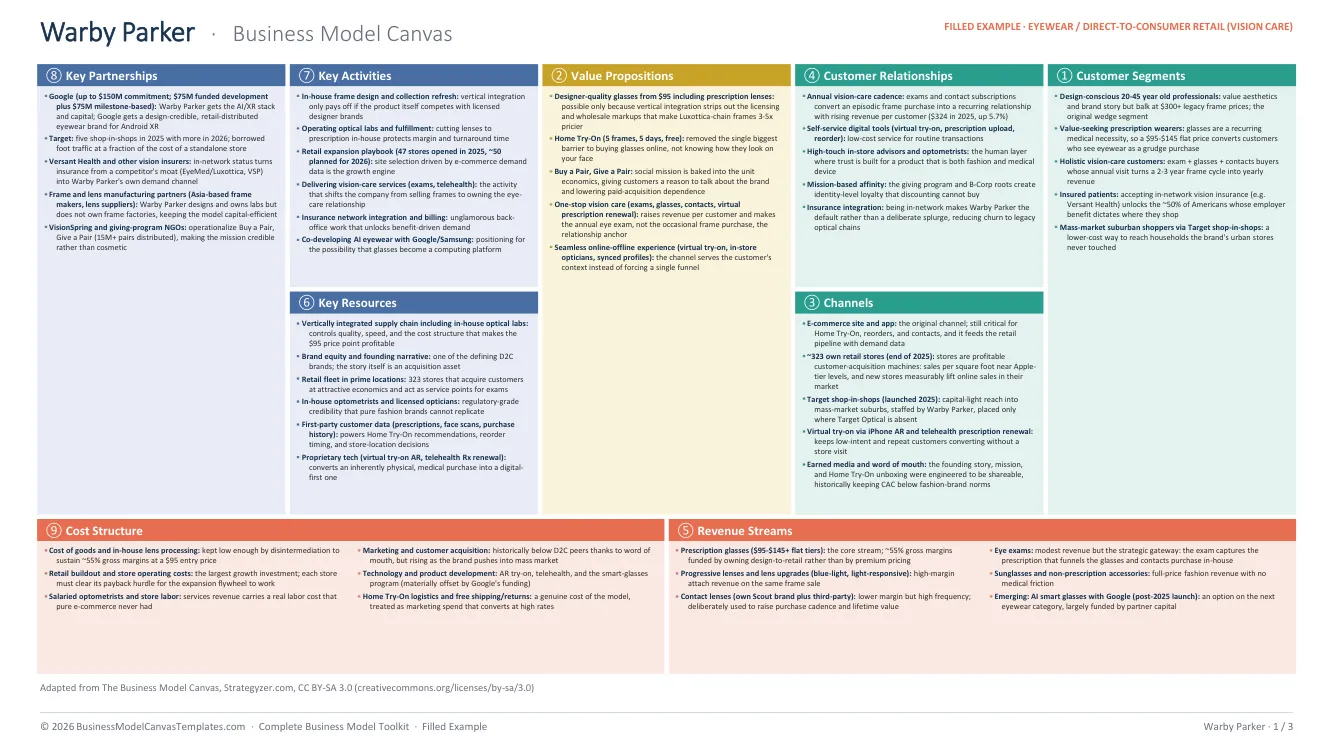
Warby Parker’s founding insight was that eyeglasses were expensive for structural reasons, not product reasons. Legacy eyewear pricing was set by a near-monopoly: Luxottica designed, manufactured, retailed, and even insured the frames it sold, stacking markups at every layer. By designing frames in-house, running its own optical labs, and selling direct, Warby Parker priced at $95 what incumbents sold for $300 or more, and still earned roughly 55% gross margins. Fifteen years later the “online glasses company” earns about two thirds of its revenue from 323 physical stores, accepts vision insurance, performs eye exams, sells contact lenses, and just posted its first full year of GAAP profitability: $1.6 million of net income on $871.9 million of revenue in 2025, up 13% year over year.
The canvas at a glance
Here is the full model mapped to the nine blocks of the business model canvas.
Customer segments
- Design-conscious professionals aged roughly 20 to 45: the original wedge, buyers who value aesthetics and brand story but balk at $300-plus legacy frame prices.
- Value-seeking prescription wearers, for whom glasses are a recurring medical necessity and a flat $95 to $145 price converts a grudge purchase.
- Holistic vision-care customers who buy exams, glasses, and contacts together, turning a 2-3 year frame cycle into yearly revenue, plus insured patients unlocked by in-network status (roughly half of Americans shop where their employer benefit points them).
- Mass-market suburban shoppers reached through Target shop-in-shops, households the brand’s urban stores never touched.
Value propositions
- Designer-quality glasses from $95 including prescription lenses, possible only because vertical integration strips out the licensing and wholesale markups that make competing frames 3-5x pricier.
- Home Try-On (5 frames, 5 days, free), which removed the single biggest barrier to buying glasses online: not knowing how they look on your face.
- One-stop vision care spanning exams, glasses, contacts, and virtual prescription renewal, making the annual eye exam rather than the occasional frame purchase the relationship anchor.
- Buy a Pair, Give a Pair: a social mission baked into the unit economics that gives customers a reason to talk about the brand and lowers paid-acquisition dependence.
Channels
- E-commerce site and app: the original channel, still critical for Home Try-On, reorders, and contacts, and the source of the demand data that feeds retail site selection.
- About 323 own retail stores at the end of 2025, with sales per square foot near Apple-tier levels; new stores measurably lift online sales in their market.
- Target shop-in-shops launched in 2025: capital-light reach into mass-market suburbs, staffed by Warby Parker and placed only where Target Optical is absent.
- Virtual try-on via iPhone AR, telehealth prescription renewal, and earned media: the founding story and Home Try-On unboxing were engineered to be shareable, historically keeping acquisition costs below fashion-brand norms.
Customer relationships
- Annual vision-care cadence: exams and contact subscriptions convert an episodic frame purchase into a recurring relationship, with revenue per customer at $324 in 2025, up 5.7%.
- Self-service digital tools (virtual try-on, prescription upload, reorder) for routine transactions, paired with high-touch in-store advisors and optometrists for a product that is both fashion and medical device.
- Insurance integration that makes Warby Parker the default rather than a deliberate splurge, reducing churn to legacy optical chains.
- Mission-based affinity from the giving program and B-Corp roots, an identity-level loyalty that discounting cannot buy.
Revenue streams
- Prescription glasses at flat $95 to $145-plus tiers: the core stream, with roughly 55% gross margins funded by owning design-to-retail rather than by premium pricing.
- High-margin attach revenue from progressive lenses and upgrades (blue-light, light-responsive) on the same frame sale.
- Contact lenses (the in-house Scout brand plus third-party): lower margin but high frequency, deliberately used to raise purchase cadence and lifetime value, alongside eye exams that capture the prescription and funnel purchases in-house.
- Sunglasses and accessories at full fashion pricing, plus an emerging option: AI smart glasses with Google, largely funded by partner capital.
Key resources
- A vertically integrated supply chain including in-house optical labs, which controls quality, speed, and the cost structure behind the $95 price point.
- A retail fleet of 323 stores in prime locations across 102 markets, plus in-house optometrists and licensed opticians whose regulatory-grade credibility pure fashion brands cannot replicate.
- Brand equity and the founding narrative, one of the defining D2C stories and an acquisition asset in itself.
- First-party customer data (prescriptions, face scans, purchase history) and proprietary tech (AR try-on, telehealth renewal) that convert a physical, medical purchase into a digital-first one.
Key activities
- In-house frame design and collection refresh: vertical integration only pays off if the product competes with licensed designer brands.
- Operating optical labs and fulfillment, protecting margin and turnaround time by cutting lenses in-house.
- Running the retail expansion playbook: 47 stores opened in 2025 (a company record), roughly 50 planned for 2026, with site selection driven by e-commerce demand data.
- Delivering vision-care services, integrating with insurance networks, and co-developing AI eyewear with Google and Samsung.
Key partnerships
- Google, with up to $150 million committed ($75 million funded development plus $75 million on milestones): Warby Parker gets the AI/XR stack and capital, Google gets a design-credible, retail-distributed eyewear brand for Android XR.
- Target, for shop-in-shops that borrow foot traffic at a fraction of the cost of a standalone store.
- Versant Health and other vision insurers, turning insurance from a competitor’s moat into Warby Parker’s own demand channel.
- Asia-based frame manufacturers and lens suppliers (Warby Parker designs and owns labs but not frame factories), plus VisionSpring and other NGOs that have distributed 15 million-plus pairs through Buy a Pair, Give a Pair.
Cost structure
- Cost of goods and in-house lens processing, kept low enough by disintermediation to sustain roughly 55% gross margins at a $95 entry price.
- Retail buildout and store operating costs, the largest growth investment, plus salaried optometrists and store labor that pure e-commerce never carried.
- Marketing spend historically below D2C peers thanks to word of mouth, but rising with the push into the mass market.
- Technology and product development (materially offset by Google’s funding) and Home Try-On logistics with free shipping and returns, treated as marketing spend that converts at high rates.
What makes this model work
Disintermediation created the margin, not cheap product. Warby Parker did not find a way to make glasses cheaper. It removed the licensing, wholesale, and retail markup layers a vertically integrated incumbent had stacked on top of them. That is why a $95 price point and a 55% gross margin can coexist: the value came out of the middlemen, and the customer and the company split it.
Stores turned out to be the cheapest acquisition channel. The famous online brand now earns roughly two thirds of revenue from physical retail. E-commerce data tells the company exactly which zip codes have dense demand, each new store lifts online sales in its market, and sales per square foot sit near Apple-tier levels. D2C was the wedge; omnichannel is the business.
The model is migrating from product to relationship. Exams, contacts, telehealth renewals, and insurance acceptance convert a once-every-2-3-years frame purchase into an annual vision-care cycle. Rising revenue per customer ($324, up 5.7% in 2025) multiplied by growing active customers (2.69 million, up 7%) is the compounding engine that finally produced GAAP profitability.
What you can steal
Attack the markup stack, not the product. Before assuming your category needs a better product, map who takes a cut between factory and customer. If one player controls multiple layers, as Luxottica did, direct distribution can fund a dramatically lower price and a healthy margin at the same time. The value propositions block is often won on structure, not features.
Design your risk-reversal to be the marketing. Home Try-On is a real logistics cost, but Warby Parker treats it as marketing spend that converts at high rates and generates shareable unboxing moments. If your product has one dominant purchase objection, build the offer that kills it and make the experience worth talking about.
Increase purchase frequency before chasing new customers. Warby Parker’s most important strategic moves (exams, contacts, insurance) all raise how often an existing customer transacts. When your natural repurchase cycle is measured in years, find the adjacent recurring need and anchor the relationship there. Mapping this against your own customer segments is a one-hour exercise with a free business model canvas template.
A fully designed version of this Warby Parker canvas, as a print-ready PDF and an editable PowerPoint alongside nine other real-company examples, ships inside the Complete Business Model Toolkit.
Sketch your own model first, free
The blank canvas with guiding questions, in all 5 formats: Word, PowerPoint, Excel, and both PDF sizes.
Instant delivery. No spam, unsubscribe anytime.