On-demand marketplace
Uber Business Model Canvas: How Uber Makes Money
Uber is an asset-light, multi-sided marketplace that monetizes a roughly 27% cut of $193B in annual gross bookings by matching independent drivers, couriers, and merchants with consumers in real time, then cross-sells each user across rides, food, grocery, and freight.
By The BMC Templates TeamLast updated
How the model works
Uber is a matching engine wearing a transportation brand. It owns almost no cars, kitchens, or trucks. Instead it maintains liquidity on two sides of a market (202M monthly consumers, 9.7M monthly drivers and couriers) and charges a commission for connecting them: roughly 30% of each ride fare, 18-20% of each delivery order, and a brokerage margin on freight. Across FY2025 that produced $52.0B in revenue on about $193B of gross bookings, a blended take rate near 27%. The drivers carry the cars, fuel, insurance, and idle time. Uber carries the algorithm, the brand, and the regulatory scar tissue. Once a user is acquired for rides, Uber monetizes the same person again through Eats, again through Uber One membership, and again by selling ads against their purchase intent.
The canvas at a glance
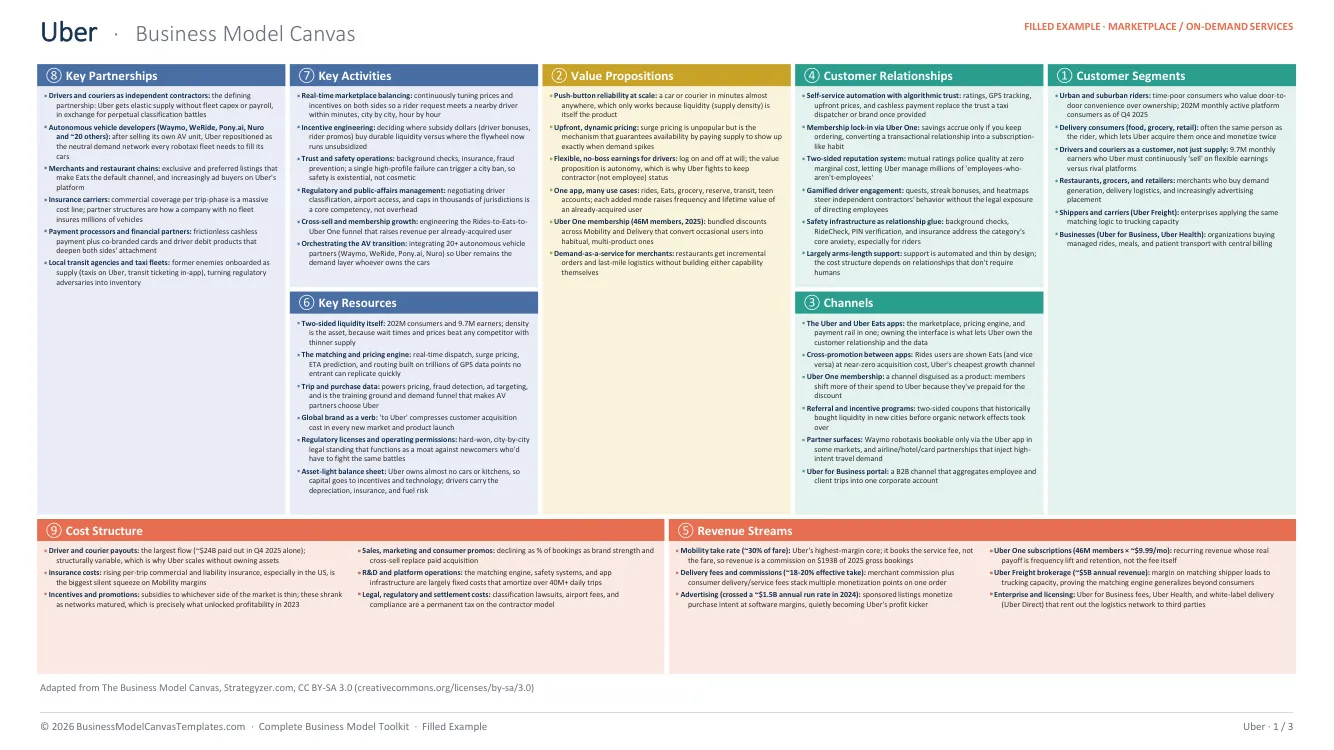
Here is Uber mapped across all nine blocks of the business model canvas.
Customer segments
- Urban and suburban riders: time-poor consumers who value door-to-door convenience over car ownership; 202M monthly active platform consumers as of Q4 2025.
- Drivers and couriers as a customer segment, not just supply: 9.7M monthly earners whom Uber must continuously sell on flexible earnings versus rival platforms.
- Merchants (restaurants, grocers, retailers) buying demand generation, delivery logistics, and increasingly advertising placement.
- Shippers and carriers on Uber Freight, plus organizations buying managed rides and meals through Uber for Business and Uber Health.
Value propositions
- Push-button reliability: a car or courier in minutes almost anywhere. Liquidity (supply density) is itself the product.
- Upfront, dynamic pricing: surge is unpopular but it is the mechanism that guarantees availability by paying supply to show up exactly when demand spikes.
- Flexible, no-boss earnings for drivers: log on and off at will. The proposition is autonomy, which is why Uber fights to keep contractor status.
- One app, many use cases, bundled by Uber One (46M members in 2025), which converts occasional users into habitual, multi-product ones.
Channels
- The Uber and Uber Eats apps: marketplace, pricing engine, and payment rail in one. Owning the interface is what lets Uber own the customer relationship and the data.
- Cross-promotion between apps: Rides users are shown Eats and vice versa at near-zero acquisition cost, Uber’s cheapest growth channel.
- Partner surfaces: Waymo robotaxis bookable only through the Uber app in some markets, plus airline, hotel, and card partnerships that inject high-intent travel demand.
- The Uber for Business portal, which aggregates employee and client trips into one corporate account.
Customer relationships
- Self-service automation with algorithmic trust: ratings, GPS tracking, upfront prices, and cashless payment replace the trust a dispatcher once provided.
- A two-sided reputation system that polices quality at zero marginal cost across millions of contractors.
- Gamified driver engagement: quests, streak bonuses, and heatmaps steer contractor behavior without the legal exposure of directing employees.
- Membership lock-in through Uber One: savings accrue only if you keep ordering, turning transactions into a subscription-like habit.
Revenue streams
- Mobility take rate of about 30% of each fare, Uber’s highest-margin core business.
- Delivery commissions at an effective 18-20% take, stacking merchant commission with consumer delivery and service fees on one order.
- Advertising, which crossed a $1.5B annual run rate in 2024: sponsored listings that monetize purchase intent at software margins.
- Uber One subscriptions (46M members at about $9.99 per month), Uber Freight brokerage (about $5B annual revenue), and enterprise licensing such as Uber Direct.
Key resources
- Two-sided liquidity itself: 202M consumers and 9.7M earners. Density beats any competitor with thinner supply on both wait times and prices.
- The matching and pricing engine: real-time dispatch, surge pricing, and ETA prediction built on trillions of GPS data points.
- Regulatory licenses and city-by-city operating permissions, a moat any newcomer would have to fight the same battles to replicate.
- An asset-light balance sheet: drivers carry depreciation, insurance, and fuel risk, so Uber’s capital goes to incentives and technology.
Key activities
- Real-time marketplace balancing: continuously tuning prices and incentives on both sides, city by city, hour by hour.
- Incentive engineering: deciding where subsidy dollars buy durable liquidity versus where the flywheel now runs unsubsidized.
- Trust, safety, and regulatory management: background checks, insurance, and negotiations over driver classification in thousands of jurisdictions. This is a core competency, not overhead.
- Orchestrating the autonomous vehicle transition by integrating 20+ AV partners so Uber remains the demand layer whoever owns the cars.
Key partnerships
- Drivers and couriers as independent contractors: the defining partnership. Uber gets elastic supply without fleet capex, in exchange for perpetual classification battles.
- Autonomous vehicle developers (Waymo, WeRide, Pony.ai, Nuro, and roughly 20 others). After selling its own AV unit, Uber repositioned as the neutral demand network every robotaxi fleet needs.
- Insurance carriers, since a company with no fleet must still insure millions of vehicles per trip phase.
- Former adversaries turned inventory: taxi fleets on Uber and transit ticketing in-app.
Cost structure
- Driver and courier payouts, the largest flow (about $24B paid out in Q4 2025 alone). Structurally variable, which is why Uber scales without owning assets.
- Rising per-trip commercial insurance, especially in the US, the biggest silent squeeze on Mobility margins.
- Incentives and promotions, which shrank as networks matured. That shrinkage is precisely what unlocked profitability in 2023.
- R&D and platform operations: largely fixed costs that amortize over 40M+ daily trips, plus permanent legal and settlement costs tied to the contractor model.
What makes this model work
The flywheel is liquidity, and it is local. More drivers mean shorter waits and lower prices, which bring more riders, which raise driver earnings per hour, which attract more drivers. But the network effect operates city by city, not globally. Uber can dominate one market and lose another, which is why it exited China and Southeast Asia in exchange for equity stakes rather than fighting entrenched local liquidity.
The margin structure is take-rate arbitrage on other people’s assets. Uber keeps roughly 27% of gross bookings while drivers bear the car, fuel, insurance, and idle-time risk. Profitability arrived in 2023 not from raising prices but from cutting incentive subsidies once liquidity became self-sustaining. The cost structure is dominated by variable payouts, so the model scales without capex.
The real earnings engine is monetizing an already-acquired user twice. Cross-sell Rides users into Eats, bundle both into Uber One, then sell ads against their purchase intent. Advertising is small revenue (a $1.5B+ run rate) but near-100% margin: a Trojan-horse profit stream inside a logistics business.
What you can steal
Treat supply as a customer segment. Uber’s canvas puts drivers in customer segments, not just under partnerships. If your marketplace’s supply side can defect to a rival tomorrow, you have to sell them a value proposition (autonomy, earnings, tools) as deliberately as you sell buyers.
Make your second product nearly free to distribute. Uber’s cheapest growth channel is showing Eats to Rides users inside an app they already open. Before you pay for new customers, ask what else you can sell to the ones you have. Your existing channels are an asset most founders under-monetize.
When a technology threatens your model, own the demand layer. Uber sold its AV unit and became the dispatch network for 20+ robotaxi fleets, betting that whoever owns 202M consumers captures value regardless of who owns the cars. Commoditize your complement instead of out-building it.
Want this canvas as a finished document? A fully designed version of the Uber canvas, as a print-ready PDF and an editable PowerPoint, ships with nine other real-company examples inside the Complete Business Model Toolkit. If you want to map your own model first, start with a free business model canvas template.
Sketch your own model first, free
The blank canvas with guiding questions, in all 5 formats: Word, PowerPoint, Excel, and both PDF sizes.
Instant delivery. No spam, unsubscribe anytime.