Consumer Fintech / Neobank
Revolut Business Model Canvas: How Revolut Makes Money
Revolut is a branchless financial superapp that acquires customers cheaply with near-interbank FX, then monetizes them across payments, deposits, trading, and subscriptions on a single global tech stack.
By The BMC Templates TeamLast updated
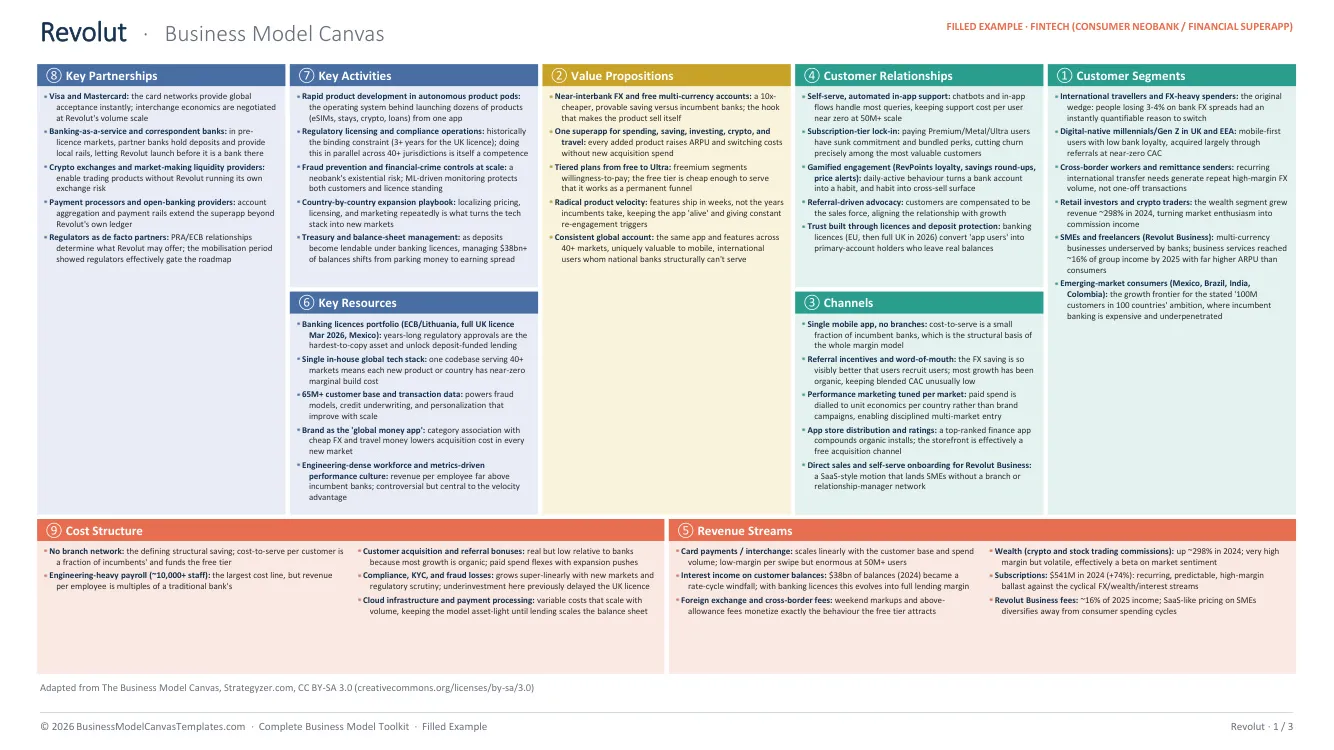
Revolut’s model starts with a product that sells itself: currency exchange at near-interbank rates, in a market where incumbent banks charge 3-4% spreads. That single, provable saving pulls in customers at close to zero acquisition cost, mostly through referrals. Once a customer is inside the app, Revolut cross-sells everything else: card payments, savings, stock and crypto trading, subscriptions, travel products, business accounts. All of it runs on one in-house tech stack across 40+ markets and zero branches, which is why a consumer bank can post roughly 25% net margins on $4 billion of 2024 revenue. The result by late 2025: 65M+ customers, about $6 billion in revenue, and a $75 billion valuation.
The canvas at a glance
Here is Revolut mapped across all nine blocks of the business model canvas.
Customer segments
- International travelers and FX-heavy spenders: the original wedge, with an instantly quantifiable reason to switch away from 3-4% bank FX spreads.
- Digital-native millennials and Gen Z in the UK and EEA, acquired largely through referrals at near-zero CAC.
- Retail investors and crypto traders: the wealth segment grew revenue roughly 298% in 2024.
- SMEs on Revolut Business (about 16% of group income by 2025) and emerging-market consumers in Mexico, Brazil, India, and Colombia, the frontier for the stated goal of 100M customers in 100 countries.
Value propositions
- Near-interbank FX and free multi-currency accounts: a 10x-cheaper, provable saving versus incumbent banks.
- One superapp for spending, saving, investing, crypto, and travel; every added product raises ARPU and switching costs without new acquisition spend.
- Tiered plans from free to Ultra, so pricing segments willingness-to-pay while the free tier stays a permanent funnel.
- A consistent global account: the same app and features across 40+ markets, something national banks structurally cannot offer mobile international users.
Channels
- A single mobile app and no branches, which keeps cost-to-serve at a small fraction of incumbent banks.
- Referral incentives and word-of-mouth: the FX saving is visible enough that users recruit users, so most growth has been organic.
- Performance marketing dialed to unit economics per country, plus app store rankings that compound organic installs.
- Self-serve onboarding and direct sales for Revolut Business, a SaaS-style motion with no relationship-manager network.
Customer relationships
- Self-serve, automated in-app support keeps support cost per user near zero at 50M+ scale.
- Subscription tiers (Premium, Metal, Ultra) create sunk commitment and cut churn among the most valuable customers.
- Gamified engagement: RevPoints loyalty, savings round-ups, and price alerts turn a bank account into a daily habit.
- Banking licenses and deposit protection convert app users into primary-account holders who leave real balances.
Revenue streams
- Card interchange: low margin per swipe, enormous at 50M+ users.
- Interest income on $38 billion of customer balances (end-2024), which becomes full lending margin as banking licenses activate.
- FX and cross-border fees, including weekend markups and above-allowance charges.
- Wealth commissions (up ~298% in 2024, but volatile), subscriptions ($541M in 2024, +74%), and Revolut Business fees (~16% of 2025 income).
Key resources
- The banking license portfolio: ECB/Lithuania, a full UK license granted March 2026 after a roughly 3-year application, and Mexico. Years-long approvals are the hardest asset to copy.
- One in-house global tech stack, so each new product or country has near-zero marginal build cost.
- 65M+ customers and their transaction data, powering fraud models, credit underwriting, and personalization.
- A brand synonymous with cheap FX and travel money, which lowers acquisition cost in every new market.
Key activities
- Rapid product development in autonomous pods: eSIMs, stays, crypto, and loans all shipped from one app.
- Regulatory licensing and compliance in parallel across 40+ jurisdictions, historically the binding constraint on growth.
- Fraud prevention at scale, a neobank’s existential risk.
- Treasury management, as $38 billion+ in balances shifts from parked cash to earning spread under banking licenses.
Key partnerships
- Visa and Mastercard for instant global card acceptance, with interchange negotiated at Revolut’s volume.
- Partner and correspondent banks that hold deposits in pre-license markets, letting Revolut launch before it is a bank there.
- Crypto exchanges and liquidity providers that enable trading without exchange risk.
- Regulators as de facto partners: the UK mobilization period showed they effectively gate the roadmap.
Cost structure
- No branch network: the defining structural saving that funds the free tier.
- Engineering-heavy payroll of 10,000+ staff, though revenue per employee runs at multiples of a traditional bank.
- Compliance, KYC, and fraud losses, which grow super-linearly with new markets; underinvestment here previously delayed the UK license.
- Cloud infrastructure and payment processing, variable costs that keep the model asset-light until lending scales the balance sheet.
What makes this model work
1. CAC arbitrage plus cross-sell. A visibly 10x-cheaper FX product acquires users almost free via referrals, then the superapp raises ARPU through trading, subscriptions, and interest income. LTV grows while CAC stays flat. That is the inverse of most neobanks, which pay to acquire and then struggle to monetize.
2. Software economics applied to banking. One tech stack serving 40+ markets means the marginal cost of offering an existing user a new product, or an existing product in a new country, is near zero. That is how the cost structure of a consumer bank supports a roughly 25% net margin.
3. A four-engine revenue portfolio. Interchange follows spend volume, interest follows the rate cycle, wealth follows market sentiment, and subscriptions are recurring. Each engine is cyclical in a different direction, which smooths an otherwise volatile fee business. One caution: 2024’s profit leaned heavily on high rates and a crypto bull market.
What you can steal
Lead with one quantifiable saving. Revolut’s wedge was a number the customer could verify: 3-4% FX spread versus near zero. If your value proposition can be stated as a provable saving, referrals do your marketing for you.
Make free users nearly free to serve. Freemium works at Revolut because no branches and automated support push cost-to-serve toward zero. Before you copy the freemium playbook, check whether your free tier is a cheap funnel or an expensive liability.
Build the moat regulators cannot fast-track. Anyone can clone the app UI. Nobody can clone a banking license portfolio that took 3+ years of scrutiny per market. Ask which asset in your model takes years of sequenced work to replicate, and start early. Comparing this canvas against a simpler startup model in a Lean Canvas makes the difference obvious: Revolut’s moat lives in the key resources block, not the product.
If you want to map a model like this yourself, start with our free business model canvas template. A fully designed version of this Revolut canvas, as a print-ready PDF plus an editable PowerPoint, ships inside the Complete Business Model Toolkit along with nine other real-company examples.
Sketch your own model first, free
The blank canvas with guiding questions, in all 5 formats: Word, PowerPoint, Excel, and both PDF sizes.
Instant delivery. No spam, unsubscribe anytime.