Travel marketplace
Airbnb Business Model Canvas: How Airbnb Makes Money
Airbnb is an asset-light, two-sided marketplace that monetizes trust: it lets ordinary people rent out their spaces (and now experiences and services) to travelers, taking a roughly 13-14% cut of every booking without owning a single property.
By The BMC Templates TeamLast updated
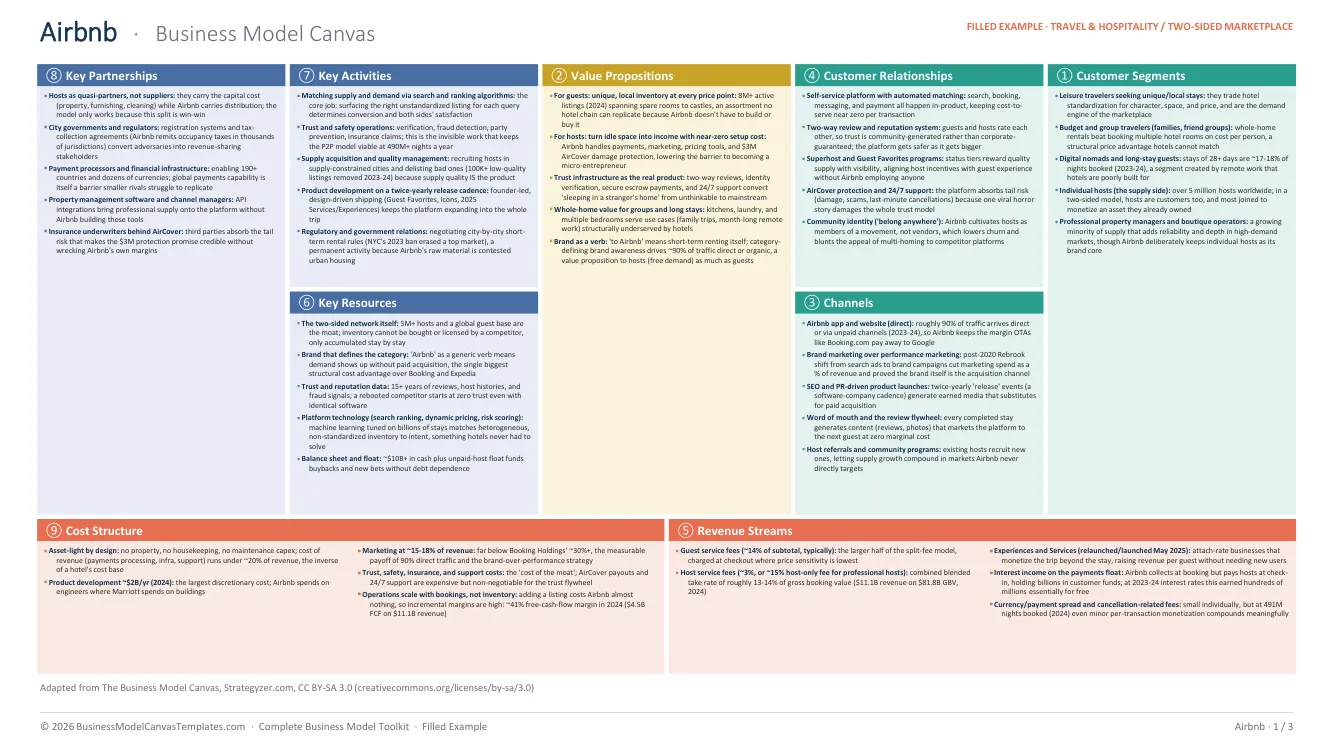
Airbnb built a hospitality giant out of other people’s houses. More than 5 million hosts supply about 8 million active listings, more rooms than the top hotel chains combined, while Airbnb owns zero real estate. The company’s actual product is trust: two-way reviews, identity verification, escrow payments, and $3 million AirCover protection turned “sleeping in a stranger’s home” from unthinkable into mainstream. For providing that trust plus global demand, Airbnb takes a blended 13-14% of every booking, which in 2024 meant $11.1 billion of revenue on $81.8 billion of gross booking value, and because hosts carry all the capital costs, roughly 41% of that revenue converted to free cash flow.
The canvas at a glance
Here is the model mapped across the nine blocks. If any block label is unfamiliar, the business model canvas overview covers what each one captures.
Customer segments
- Leisure travelers seeking unique, local stays: they trade hotel standardization for character, space, and price, and drive the demand side.
- Budget and group travelers: whole-home rentals beat booking multiple hotel rooms on cost per person, a structural advantage hotels cannot match.
- Digital nomads and long-stay guests: stays of 28+ days were roughly 17-18% of nights booked in 2023-24, a remote-work segment hotels are poorly built for.
- Hosts are customers too: 5 million+ individuals monetizing an asset they already owned, plus professional property managers who add depth in high-demand markets.
Value propositions
- For guests: unique local inventory at every price point, 8 million+ active listings from spare rooms to castles, an assortment no chain can replicate because Airbnb does not have to build or buy it.
- For hosts: turn idle space into income at near-zero setup cost, with Airbnb handling payments, marketing, pricing tools, and $3 million AirCover damage protection.
- Trust infrastructure as the real product: two-way reviews, identity verification, secure escrow, and 24/7 support.
- Whole-home value for groups and month-long stays, and a brand so strong that “to Airbnb” means short-term renting itself, which delivers free demand to hosts.
Channels
- Direct app and website: roughly 90% of traffic arrives direct or via unpaid channels, so Airbnb keeps the margin OTAs like Booking.com pay away to Google.
- Brand marketing over performance marketing: the post-2020 shift from search ads to brand campaigns cut marketing as a share of revenue.
- Twice-yearly product release events, run on a software-company cadence, that generate earned media in place of paid acquisition.
- The review flywheel and host referrals: every completed stay produces reviews and photos that market the platform to the next guest at zero marginal cost.
Customer relationships
- Self-service platform: search, booking, messaging, and payment all happen in-product, keeping cost-to-serve near zero per transaction.
- Two-way reputation system: guests and hosts rate each other, so trust is community-generated and the platform gets safer as it gets bigger.
- Superhost and Guest Favorites tiers that reward quality supply with visibility, aligning host incentives with guest experience without Airbnb employing anyone.
- AirCover and 24/7 support absorbing tail risk, plus a “belong anywhere” community identity that treats hosts as members of a movement rather than vendors.
Revenue streams
- Guest service fees of about 14% of the booking subtotal, charged at checkout where price sensitivity is lowest.
- Host service fees of about 3% (or a roughly 15% host-only fee for professionals), for a blended take rate near 13.5%: $11.1 billion revenue on $81.8 billion GBV in 2024.
- Experiences and Services, launched and relaunched in May 2025, raising revenue per guest without needing new users.
- Interest on the payments float: Airbnb collects at booking and pays hosts at check-in, holding billions that earned hundreds of millions at 2023-24 rates, plus small per-transaction fees that compound across 491 million booked nights.
Key resources
- The two-sided network itself: 5 million+ hosts and a global guest base that a competitor cannot buy or license, only accumulate stay by stay.
- A category-defining brand that makes demand show up without paid acquisition, the biggest structural cost advantage over Booking and Expedia.
- 15+ years of trust and reputation data: reviews, host histories, and fraud signals a rebooted rival starts without, even with identical software.
- Platform technology (search ranking, dynamic pricing, risk scoring) tuned on billions of stays, plus a balance sheet of $10 billion+ in cash and float.
Key activities
- Matching supply and demand: surfacing the right unstandardized listing for each query determines conversion and both sides’ satisfaction.
- Trust and safety operations: verification, fraud detection, party prevention, and insurance claims, the invisible work that keeps a peer-to-peer model viable at 490 million+ nights a year.
- Supply acquisition and quality management, including removing 100,000+ low-quality listings in 2023-24, because supply quality is the product.
- Regulatory and government relations, negotiated city by city; New York’s 2023 rules erased a top market overnight.
Key partnerships
- Hosts as quasi-partners: they carry the capital cost of property, furnishing, and cleaning while Airbnb carries distribution, a split that only works because both sides win.
- City governments and regulators: tax-collection agreements in thousands of jurisdictions convert adversaries into revenue-sharing stakeholders.
- Payment processors enabling 190+ countries and dozens of currencies, itself a barrier smaller rivals struggle to replicate.
- Property management software integrations that bring professional supply on-platform, and insurance underwriters who make the $3 million AirCover promise credible.
Cost structure
- Asset-light by design: no property, no housekeeping, no maintenance capex; cost of revenue runs under about 20% of revenue, the inverse of a hotel.
- Product development around $2 billion in 2024, the largest discretionary cost: Airbnb spends on engineers where Marriott spends on buildings.
- Marketing at 15-18% of revenue, far below Booking Holdings’ 30%+, the measurable payoff of 90% direct traffic.
- Trust, safety, insurance, and support: the cost of the moat. Operations scale with bookings rather than inventory, producing a roughly 41% free cash flow margin ($4.5 billion FCF on $11.1 billion revenue in 2024).
What makes this model work
The flywheel is trust, not listings. More hosts bring more choice, which brings more guests, which generates more reviews and host earnings, which attracts more hosts. The compounding asset is the review base: a competitor can copy the app in a quarter but not 15 years of reputation data. That is why these network effects are stickier than in ride-hailing, where supply multi-homes easily.
Airbnb monetizes other people’s capital. Hosts invest the property, furniture, and labor; Airbnb takes 13-14% of gross booking value for providing demand and trust. The split produces hotel-industry revenue with software-industry margins because a new listing costs Airbnb almost nothing to add.
Becoming a verb is a P&L line, not a vanity metric. With about 90% of visits arriving direct or unpaid, Airbnb keeps the 15-20 points of margin that hotels and even Booking.com surrender to Google. The float adds a quiet second business: interest on billions held between guest payment and host payout, revenue with no marginal cost and no customer.
What you can steal
Sell the trust layer, not the asset. If your model involves strangers transacting, the reviews, verification, guarantees, and dispute handling are the product. Budget for them as the moat, not as overhead, and write them explicitly into your value propositions block for each side of the market.
Treat both sides of a marketplace as customer segments. Airbnb’s hosts are customers with their own value proposition (income, free demand, protection), their own relationships (Superhost status, community identity), and their own economics. If you are mapping a marketplace, split your customer segments block the same way; a free business model canvas template makes it easy to run one canvas per side before merging them.
Know your politically contested input, and diversify before you must. Airbnb’s raw material is urban housing, and cities can delete supply by law, as New York did in 2023. The 2025 push into Experiences and Services raises revenue per guest so growth depends less on adding contested inventory. Ask what regulation could remove from your model overnight, and build the second engine early.
A fully designed version of this Airbnb canvas, as a print-ready PDF plus an editable PowerPoint, ships alongside nine other real-company breakdowns in the Complete Business Model Toolkit.
Sketch your own model first, free
The blank canvas with guiding questions, in all 5 formats: Word, PowerPoint, Excel, and both PDF sizes.
Instant delivery. No spam, unsubscribe anytime.