Franchise quick-service restaurants
McDonald's Business Model Canvas: How the World's Biggest Landlord Sells Burgers
McDonald's is less a burger chain than a franchisor-landlord that monetizes roughly $140B of customer spending it doesn't book as revenue, collecting rent and royalties from ~95% franchised restaurants while owning the real estate underneath them.
By The BMC Templates TeamLast updated
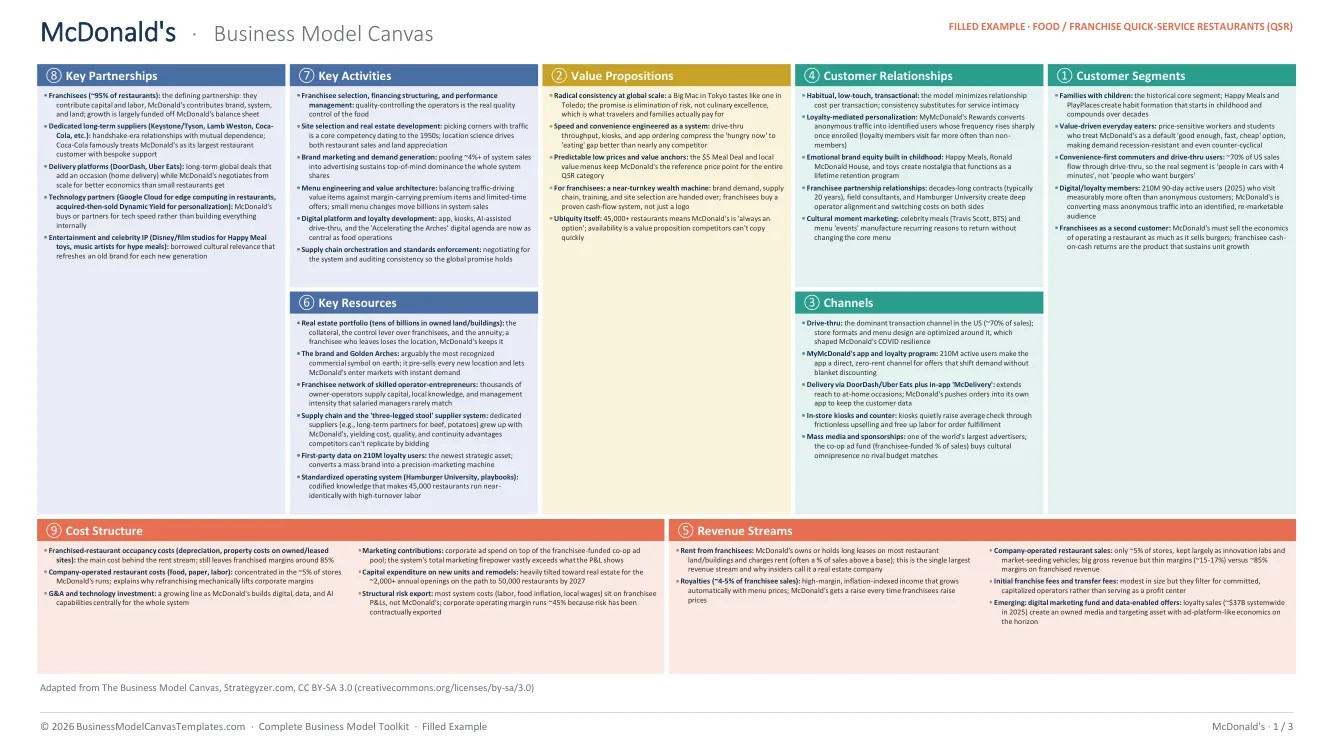
McDonald’s booked $26.9 billion of revenue in 2025 while customers spent roughly $140 billion at its restaurants. That gap is the whole model. Corporate McDonald’s does not primarily sell burgers; it sells a business system to franchisees, who run about 95% of the 45,000+ restaurants, and it collects rent and royalties on their sales. Because McDonald’s owns or controls the land under most locations, it earns landlord income on top of brand income, with food costs, labor inflation, and demand risk sitting on franchisee P&Ls. The result is a corporate operating margin around 45%, on par with elite software companies, generated by a burger chain. Mapping this on a business model canvas shows exactly how the pieces interlock.
The canvas at a glance
Customer segments
- Families with children: the historical core. Happy Meals and PlayPlaces build habits in childhood that compound for decades.
- Value-driven everyday eaters and convenience-first commuters: roughly 70% of US sales flow through the drive-thru, so the real segment is people in cars with four minutes, and demand holds up in recessions.
- Digital and loyalty members: 210 million 90-day active users in 2025 who visit measurably more often than anonymous customers.
- Franchisees as a second customer: McDonald’s must sell restaurant economics as convincingly as it sells burgers, because franchisee returns are what sustain unit growth.
Value propositions
- Radical consistency at global scale: a Big Mac in Tokyo tastes like one in Toledo. The promise is elimination of risk, not culinary excellence.
- Speed engineered as a system: drive-thru throughput, kiosks, and app ordering compress the gap between “hungry now” and eating.
- Predictable value anchors like the $5 Meal Deal keep McDonald’s the reference price for the whole QSR category.
- For franchisees: a near-turnkey cash-flow system. Brand demand, supply chain, training, and site selection come included.
Channels
- Drive-thru dominates US transactions (~70% of sales); store formats and menus are optimized around it.
- The MyMcDonald’s app: 210 million active users make it a direct, zero-rent channel for targeted offers.
- Delivery via DoorDash and Uber Eats, plus in-app McDelivery to keep the customer data in-house.
- In-store kiosks quietly raise average check through frictionless upselling, while a franchisee-funded co-op ad pool buys mass-media omnipresence.
Customer relationships
- Habitual and low-touch with diners: consistency substitutes for service intimacy, keeping relationship cost per transaction near zero.
- Loyalty-mediated personalization: enrolled members visit far more often than non-members.
- Emotional equity built in childhood (Happy Meals, Ronald McDonald House) functions as a lifetime retention program.
- Deep franchisee partnerships: 20-year contracts, field consultants, and Hamburger University create switching costs on both sides.
Revenue streams
- Rent from franchisees: the single largest stream, often charged as a percentage of sales above a base on McDonald’s-owned sites (roughly 8-15% of sales).
- Royalties of about 4-5% of franchisee sales: high margin and inflation-indexed, so McDonald’s gets a raise every time franchisees raise prices.
- Company-operated sales from the ~5% of stores it runs itself, kept mostly as innovation labs; margins there run ~15-17% versus ~85% on franchised revenue.
- Emerging digital income: loyalty-driven sales hit roughly $37 billion systemwide in 2025, creating an owned media and targeting asset.
Key resources
- A real estate portfolio worth tens of billions: the annuity, the collateral, and the enforcement lever over franchisees.
- The Golden Arches brand, which pre-sells every new location.
- A network of owner-operator franchisees supplying capital, local knowledge, and management intensity.
- Dedicated long-term suppliers, first-party data on 210 million loyalty users, and a codified operating system (Hamburger University, playbooks) that keeps 45,000 restaurants running near-identically.
Key activities
- Franchisee selection and performance management: quality-controlling operators is the real quality control of the food.
- Site selection and real estate development, a core competency since the 1950s.
- Menu engineering and value architecture: small menu changes move billions in system sales.
- Brand marketing, digital platform development, and supply chain orchestration for the entire system.
Key partnerships
- Franchisees running ~95% of restaurants: they contribute capital and labor; McDonald’s contributes brand, system, and land.
- Dedicated suppliers (Tyson/Keystone, Lamb Weston, Coca-Cola) with handshake-era relationships and mutual dependence.
- Delivery platforms (DoorDash, Uber Eats) negotiated from scale, plus tech partners like Google Cloud.
- Entertainment and celebrity IP, from Disney Happy Meal toys to Travis Scott and BTS meals, that refreshes the brand for each generation.
Cost structure
- Occupancy costs (depreciation, property costs) behind the rent stream, which still leave franchised margins around 85%.
- Food, paper, and labor costs concentrated in the ~5% of company-operated stores.
- Growing G&A and technology investment, marketing contributions, and capital expenditure for 2,000+ annual openings toward 50,000 restaurants by 2027.
- The structural point: most system costs sit on franchisee P&Ls, not McDonald’s. Risk has been contractually exported.
What makes this model work
1. The landlord moat. Former CFO Harry Sonneborn’s line, “we are not in the food business, we are in the real estate business,” is structurally true. Owning the dirt under franchisees gives McDonald’s an appreciating asset, senior-creditor-like security, and enforcement power: break the rules and you lose the location. Rent typically exceeds royalties as an income stream, which almost no other franchisor can claim.
2. Risk export as a margin engine. Refranchising to ~95% moved food costs, labor inflation, and demand volatility onto franchisee P&Ls while corporate keeps a percentage-of-sales toll. That produces ~45% operating margins and revenue streams that rise automatically with menu-price inflation: an inflation-hedged annuity disguised as a burger chain.
3. A franchisee-funded flywheel. More restaurants mean a bigger pooled ad fund and more supplier volume, which lowers costs and strengthens the brand, which improves franchisee unit economics, which attracts more capital-rich operators wanting in. Every element is funded by franchisees, so the flywheel spins with minimal corporate capital.
What you can steal
Sell the system, not the product. McDonald’s customers eat burgers, but McDonald’s Corporation sells a business system and collects a toll on other people’s operations. Ask whether your expertise, playbook, or platform is worth more than the end product itself. The canvas of a franchisor is not the canvas of a restaurant, and drawing both on a free business model canvas template makes the difference obvious fast.
Structure revenue to ride inflation. Percentage-of-sales royalties and rent mean McDonald’s income grows every time franchisees raise prices, with zero corporate effort. Wherever possible, index your pricing to your customers’ revenue rather than fixing it in absolute terms.
Convert anonymous traffic into owned relationships. The loyalty program turned the model’s one weakness, anonymous customers owned by no one, into first-party data on 210 million people, with a target of 250 million by 2027. If your business runs on anonymous transactions, the highest-leverage move may be identification, not acquisition. That belongs in your customer relationships block from day one.
A fully designed version of this McDonald’s canvas, as a print-ready PDF plus an editable PowerPoint, ships with nine other real-company breakdowns inside the Complete Business Model Toolkit. If you want to study more models like this first, the rest of the series lives in the examples library.
Sketch your own model first, free
The blank canvas with guiding questions, in all 5 formats: Word, PowerPoint, Excel, and both PDF sizes.
Instant delivery. No spam, unsubscribe anytime.