Payments infrastructure
Stripe Business Model Canvas: How a 2.9% Fee Becomes a 0.36% Business
Stripe sells the internet's economic plumbing as an API: it abstracts the messy card-network, banking, and compliance stack into developer-friendly building blocks, takes a thin slice of every transaction, and then upsells software on top of the payment flow it already controls.
By The BMC Templates TeamLast updated
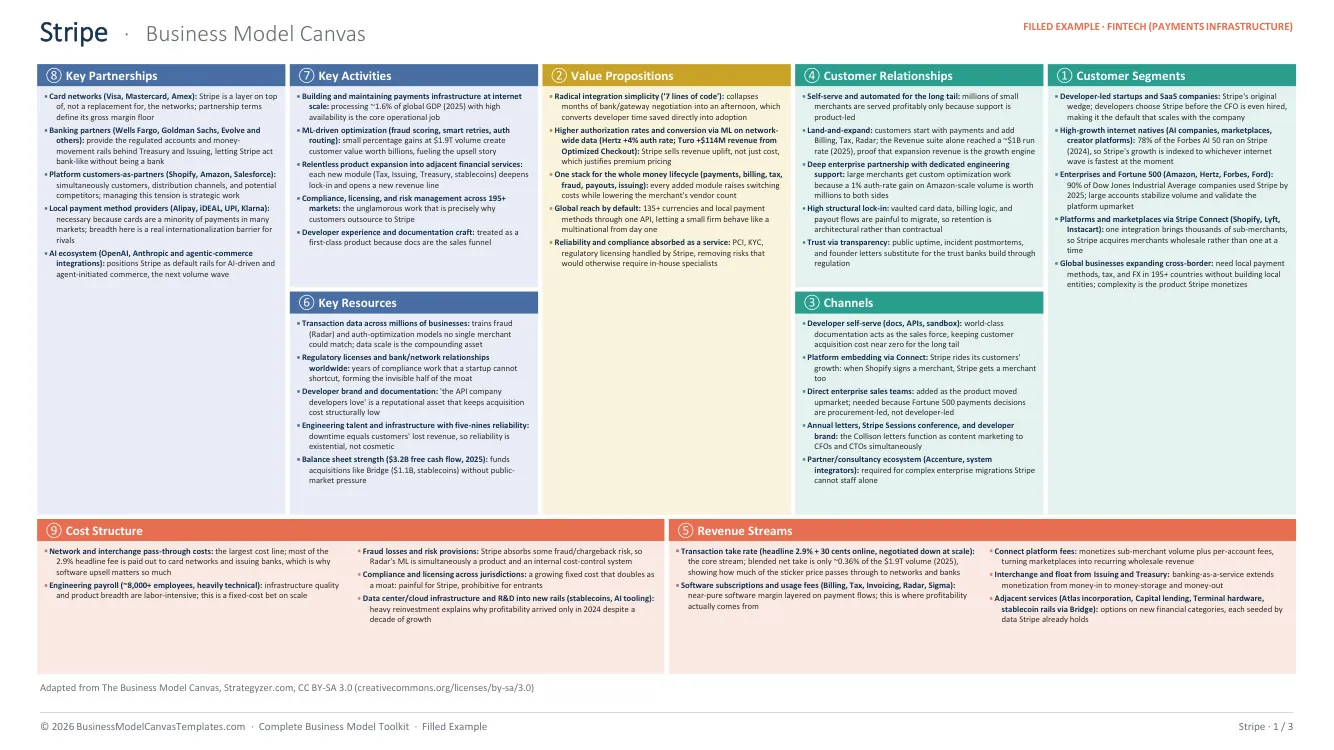
Stripe charges merchants a headline 2.9% plus 30 cents per online transaction, but nets only about 0.36% of the $1.9 trillion that flowed through it in 2025. Almost the entire sticker price passes through to card networks and issuing banks. That gap defines the model: payments alone is a thin-margin distribution business, so Stripe uses the payment relationship as a wedge to sell high-margin software, Billing, Tax, Radar, and Treasury, on top of money flows it already controls. Developers integrate it in an afternoon, each added module deepens lock-in, and Stripe’s revenue compounds with the internet economy itself: $6.8 billion in revenue and $3.2 billion in free cash flow in 2025, on volume equal to roughly 1.6% of global GDP. Here is how that looks when you map it onto a canvas.
The canvas at a glance
Customer segments
- Developer-led startups and SaaS companies: the original wedge. Developers choose Stripe before the CFO is hired, making it the default that scales with the company.
- High-growth internet natives: 78% of the Forbes AI 50 ran on Stripe in 2024, so growth is indexed to whichever internet wave is fastest.
- Enterprises: Amazon, Hertz, Forbes, Ford. By 2025, 90% of Dow Jones Industrial Average companies used Stripe in some form.
- Platforms and marketplaces via Connect (Shopify, Lyft, Instacart): one integration brings thousands of sub-merchants, so Stripe acquires merchants wholesale.
Value propositions
- Radical integration simplicity (“7 lines of code”) collapses months of bank and gateway negotiation into an afternoon.
- Revenue uplift, not just cost savings: ML on network-wide data raised Hertz’s authorization rate 4%, and Optimized Checkout added $114M of revenue for Turo.
- One stack for the whole money lifecycle: payments, billing, tax, fraud, payouts, issuing. Each module cuts vendor count and raises switching costs.
- Global reach by default: 135+ currencies and local payment methods in 195+ countries through one API, with PCI, KYC, and licensing absorbed as a service.
Channels
- Developer self-serve: world-class documentation acts as the sales force, keeping acquisition cost near zero for the long tail.
- Platform embedding via Connect: when Shopify signs a merchant, Stripe gets a merchant too.
- Direct enterprise sales teams, added as Fortune 500 deals became procurement-led rather than developer-led.
- The Collison annual letters, Stripe Sessions, and a partner ecosystem (Accenture, system integrators) for complex migrations.
Customer relationships
- Self-serve and automated for millions of small merchants; support is product-led by necessity.
- Land-and-expand: customers start with payments and add Billing, Tax, and Radar. The Revenue suite alone reached a ~$1B run rate in 2025.
- Dedicated engineering support for enterprises, where a 1% authorization gain at Amazon scale is worth millions to both sides.
- Structural lock-in: vaulted card data, billing logic, and payout flows are painful to migrate, so retention is architectural rather than contractual.
Revenue streams
- Transaction take rate: 2.9% + 30 cents headline, negotiated down at scale, blending to a net ~0.36% of volume after network and bank pass-throughs.
- Software subscriptions and usage fees (Billing, Tax, Invoicing, Radar, Sigma): near-pure software margin and the real source of profitability.
- Connect platform fees that turn marketplaces into recurring wholesale revenue.
- Interchange and float from Issuing and Treasury, plus adjacent bets: Atlas incorporation, Capital lending, Terminal hardware, and stablecoin rails via Bridge.
Key resources
- Transaction data across millions of businesses: trains fraud and authorization models no single merchant could match. Data scale is the compounding asset.
- Regulatory licenses and bank and network relationships worldwide: years of compliance work a startup cannot shortcut.
- Developer brand and documentation, plus engineering talent running five-nines infrastructure.
- Balance sheet strength: $3.2B free cash flow in 2025 funds acquisitions like Bridge ($1.1B) without public-market pressure.
Key activities
- Operating payments infrastructure at internet scale: processing ~1.6% of global GDP with high availability.
- ML-driven optimization (fraud scoring, smart retries, auth routing), where small percentage gains at $1.9T volume create billions in customer value.
- Relentless product expansion into adjacent financial services, each module deepening lock-in.
- Compliance and risk management across 195+ markets, and treating documentation as a first-class product because docs are the sales funnel.
Key partnerships
- Card networks (Visa, Mastercard, Amex): Stripe is a layer on top of, not a replacement for, the networks. Their terms set its gross margin floor.
- Banking partners (Wells Fargo, Goldman Sachs, Evolve) provide the regulated rails that let Stripe act bank-like without being a bank.
- Platform customers-as-partners like Shopify and Amazon: simultaneously customers, distribution, and potential competitors.
- Local payment method providers (Alipay, iDEAL, UPI, Klarna) and AI ecosystem integrations (OpenAI, Anthropic) positioning Stripe as rails for agent-initiated commerce.
Cost structure
- Network and interchange pass-throughs: the largest cost line, and the reason software upsell matters so much.
- Engineering payroll across 8,000+ heavily technical employees: a fixed-cost bet on scale.
- Fraud losses and risk provisions, which make Radar both a product and an internal cost control.
- Compliance across jurisdictions (painful for Stripe, prohibitive for entrants) plus heavy R&D into new rails, which is why profitability arrived only in 2024.
What makes this model work
1. The take-rate illusion funds a software business. Stripe’s $6.8B of revenue on $1.9T of volume shows how little of the 2.9% headline it keeps. Payments is the distribution channel; the profit engine is the software layered on top, with the Revenue suite alone at a ~$1B run rate. The revenue streams block only makes sense read together with the cost structure.
2. Growth is indexed to the internet economy, not market share. Volume grew 38% in 2024 and 34% in 2025 while global e-commerce grew single digits, because Stripe positions itself under each new wave: SaaS, then marketplaces, then creators, then AI. It wins by choosing customers who grow faster than the market.
3. A data flywheel wrapped in a compliance shell. Every transaction improves fraud and authorization models, which raise merchants’ revenue, which attracts more merchants and more data. Meanwhile, licenses and bank relationships in 195+ countries form a barrier capital alone cannot buy quickly. A competitor must replicate both at once.
What you can steal
Make distribution architectural, not promotional. Developers integrate Stripe before procurement exists because the documentation is the sales force, and Connect makes platforms recruit merchants on Stripe’s behalf. Ask what part of your product could do the selling for you, and design your channels block around it.
Land thin, expand rich. Stripe enters on a near-commodity transaction fee, then sells high-margin software into a relationship it already owns. If your entry product has thin margins, treat it as the acquisition channel for what you will sell next, and sketch both stages on a free business model canvas template before committing to pricing.
Build switching costs from workflow, not contracts. Vaulted card data, billing logic, and payout flows make leaving Stripe an engineering project, so churn stays low without lock-in clauses. Retention you architect into the product is worth more than retention you negotiate. Stripe also shows the payoff of patience: 14 years pre-profit, then $3.2B in free cash flow and a $159B valuation by February 2026.
A fully designed version of this Stripe canvas, as a print-ready PDF plus an editable PowerPoint, ships alongside nine other company breakdowns in the Complete Business Model Toolkit. To compare it with a very different kind of platform economics, see the Airbnb example.
Sketch your own model first, free
The blank canvas with guiding questions, in all 5 formats: Word, PowerPoint, Excel, and both PDF sizes.
Instant delivery. No spam, unsubscribe anytime.