Freelance services marketplace
Upwork Business Model Canvas: How Upwork Makes Money
Upwork is a two-sided talent marketplace that monetizes the full lifecycle of remote knowledge work (matching, contracting, payment, and compliance), taking a cut of every dollar billed plus fees for access and visibility on both sides.
By The BMC Templates TeamLast updated
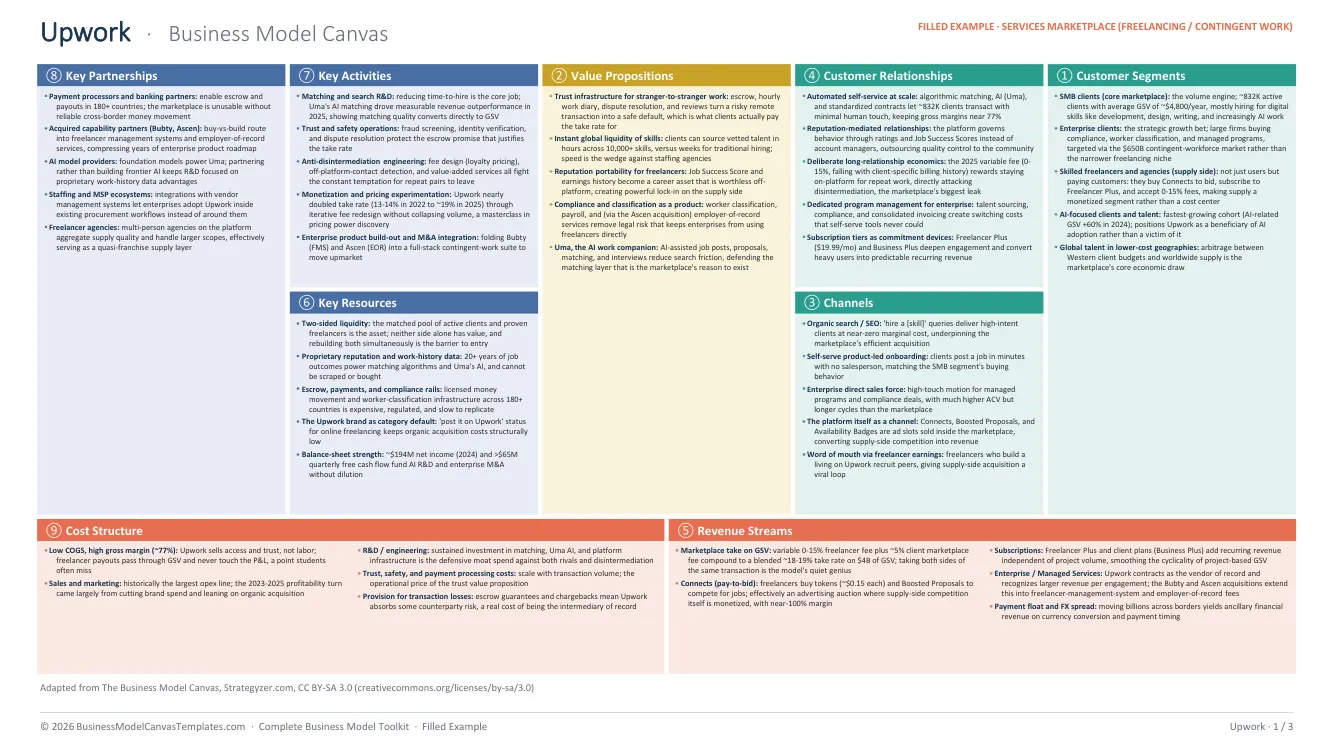
Upwork sells trust, not labor. Its two-sided marketplace matches roughly 832,000 active clients with freelancers across 10,000-plus skills, then wraps every engagement in escrow, an hourly work diary, dispute resolution, and reviews, the infrastructure that turns a risky stranger-to-stranger remote transaction into a safe default. About $4 billion of client spending flowed through the platform in 2024, but freelancer payouts pass through escrow without ever touching the income statement. Upwork’s revenue is the toll: $769.3 million in 2024, up 12%, at roughly 77% gross margin, converting to about $194 million of GAAP net income. The quiet genius is that the same transaction gets monetized three times: a freelancer fee, a client fee, and pay-to-bid Connects before the work even starts.
The canvas at a glance
Here is the full model mapped to the nine blocks of the business model canvas.
Customer segments
- SMB clients, the volume engine: roughly 832,000 active clients averaging about $4,800 in annual gross services volume, mostly hiring for development, design, writing, and increasingly AI work.
- Enterprise clients, the strategic growth bet: large firms buying compliance, worker classification, and managed programs, targeted via the $650 billion contingent-workforce market rather than the narrower freelancing niche.
- Skilled freelancers and agencies, a monetized segment rather than a cost center: they buy Connects to bid, subscribe to Freelancer Plus, and pay 0-15% fees.
- AI-focused clients and talent, the fastest-growing cohort (AI-related GSV up 60% in 2024), plus global talent in lower-cost geographies whose arbitrage against Western budgets is the marketplace’s core economic draw.
Value propositions
- Trust infrastructure for stranger-to-stranger work: escrow, the hourly work diary, dispute resolution, and reviews are what clients actually pay the take rate for.
- Instant global liquidity of skills: vetted talent sourced in hours across 10,000-plus skills, versus weeks for traditional hiring; speed is the wedge against staffing agencies.
- Reputation portability for freelancers: Job Success Score and earnings history become a career asset that is worthless off-platform, creating powerful supply-side lock-in.
- Compliance as a product (classification, payroll, and employer-of-record services via the Ascen acquisition), plus Uma, the AI work companion that assists job posts, proposals, matching, and interviews.
Channels
- Organic search: “hire a [skill]” queries deliver high-intent clients at near-zero marginal cost, underpinning efficient acquisition.
- Self-serve product-led onboarding for SMBs (post a job in minutes, no salesperson) alongside a direct sales force for enterprise deals with much higher contract values but longer cycles.
- The platform itself as a channel: Connects, Boosted Proposals, and Availability Badges are ad slots sold inside the marketplace, converting supply-side competition into revenue.
- Word of mouth via freelancer earnings: people who build a living on Upwork recruit peers, giving supply-side acquisition a viral loop.
Customer relationships
- Automated self-service at scale: algorithmic matching, Uma, and standardized contracts let roughly 832,000 clients transact with minimal human touch, keeping gross margins near 77%.
- Reputation-mediated governance: ratings and Job Success Scores police behavior instead of account managers, outsourcing quality control to the community.
- Deliberate long-relationship economics: the 2025 variable fee falls with client-specific billing history, rewarding on-platform loyalty and directly attacking disintermediation.
- Dedicated program management for enterprise and subscription tiers (Freelancer Plus at $19.99 per month, Business Plus) as commitment devices that convert heavy users into recurring revenue.
Revenue streams
- The marketplace take on GSV: a variable 0-15% freelancer fee plus a roughly 5% client fee compound to a blended 18-19% take rate on about $4 billion of GSV.
- Connects: freelancers buy tokens at roughly $0.15 each, plus Boosted Proposals, effectively an advertising auction on supply-side competition with near-100% margin.
- Subscriptions (Freelancer Plus, Business Plus) that add recurring revenue independent of project volume, smoothing the cyclicality of project-based GSV.
- Enterprise and managed services, where Upwork contracts as vendor of record and recognizes larger revenue per engagement, plus ancillary financial revenue from FX spread and payment float on billions moved across borders.
Key resources
- Two-sided liquidity: the matched pool of active clients and proven freelancers is the asset; neither side alone has value, and rebuilding both simultaneously is the barrier to entry.
- Proprietary reputation and work-history data: 20-plus years of job outcomes power the matching algorithms and Uma, and cannot be scraped or bought.
- Escrow, payments, and compliance rails across 180-plus countries: licensed, regulated, expensive, and slow to replicate.
- The Upwork brand as category default, keeping organic acquisition costs structurally low, plus balance-sheet strength (about $194 million of 2024 net income, over $65 million in quarterly free cash flow) that funds AI R&D and M&A without dilution.
Key activities
- Matching and search R&D: reducing time-to-hire is the core job, and Uma’s AI matching drove measurable revenue outperformance in 2025.
- Trust and safety operations: fraud screening, identity verification, and dispute resolution protect the escrow promise that justifies the take rate.
- Anti-disintermediation engineering: loyalty-based fee design, off-platform-contact detection, and value-added services that fight the constant temptation for repeat pairs to leave.
- Monetization experimentation (take rate rose from 13-14% in 2022 to about 19% in 2025 without collapsing volume) and enterprise build-out via the Bubty and Ascen integrations.
Key partnerships
- Payment processors and banking partners enabling escrow and payouts in 180-plus countries; the marketplace is unusable without reliable cross-border money movement.
- Acquired capability partners Bubty (freelancer management system) and Ascen (employer of record), a buy-vs-build route that compressed years of enterprise roadmap.
- AI model providers powering Uma: partnering rather than building frontier models keeps R&D focused on the proprietary work-history data advantage.
- Staffing and MSP ecosystems (integrations with vendor management systems so enterprises adopt Upwork inside existing procurement) and multi-person freelancer agencies that act as a quasi-franchise supply layer.
Cost structure
- Low COGS at roughly 77% gross margin: Upwork sells access and trust, not labor, and freelancer payouts never touch the P&L.
- Sales and marketing, historically the largest opex line; the 2023-2025 profitability turn came largely from cutting brand spend and leaning on organic acquisition.
- R&D and engineering: sustained investment in matching, Uma, and platform infrastructure is the defensive moat spend.
- Trust, safety, and payment processing costs that scale with volume, plus a provision for transaction losses, since escrow guarantees and chargebacks mean Upwork absorbs some counterparty risk.
What makes this model work
The flywheel is liquidity, but the moat is reputation that only points inward. More clients attract more freelancers in a classic network effect, yet what actually stops multi-homing is that a freelancer’s Job Success Score and earnings history are worthless on any other platform. Supply-side switching costs do the work that network effects alone cannot.
Growth came from pricing power, not just volume. Upwork nearly doubled its blended take rate, from about 13.8% in 2022 to about 18.7% in 2025, through iterative fee redesign, with revenue growing faster than GSV. Monetizing the same transaction three times (freelancer fee, client fee, and Connects before the deal even happens) is a masterclass in discovering how much value the revenue streams block can actually capture.
Fee structure doubles as retention strategy. Disintermediation is the existential threat for any services marketplace: once a client and freelancer trust each other, why keep paying the toll? Upwork’s 2025 answer drops fees toward 0% as a freelancer’s history with a specific client grows, deliberately making loyalty cheaper than leaving. Pricing here is defense, not just monetization.
What you can steal
Charge for trust, not for the work itself. Upwork’s take rate is justified by escrow, verification, and dispute resolution, not by the labor flowing through it. If your marketplace or service reduces counterparty risk, price that risk reduction explicitly; it is usually worth more than the matching. Sketch where trust sits in your own value propositions before you set a fee.
Monetize both sides, and monetize the competition between them. Connects turn freelancers’ bidding competition into a near-100%-margin advertising auction. Look for places where your users compete for scarce attention (listings, slots, rankings) and sell position rather than leaving it to chance.
Design switching costs into the value you deliver. Reputation portability sounds generous until you notice it only works inward. Any accumulated asset your users build on your platform (history, scores, data, workflows) is retention infrastructure if it cannot leave. If you are mapping a marketplace of your own, a free business model canvas template forces you to name that lock-in explicitly instead of hoping network effects save you.
A fully designed version of this Upwork canvas, as a print-ready PDF and an editable PowerPoint alongside nine other real-company examples, ships inside the Complete Business Model Toolkit.
Sketch your own model first, free
The blank canvas with guiding questions, in all 5 formats: Word, PowerPoint, Excel, and both PDF sizes.
Instant delivery. No spam, unsubscribe anytime.