Productivity SaaS
Notion Business Model Canvas: How Notion Makes Money
Notion sells a freemium, per-seat all-in-one workspace that lands with individuals for free, spreads bottom-up into their companies, and then monetizes teams through paid tiers and bundled AI.
By The BMC Templates TeamLast updated
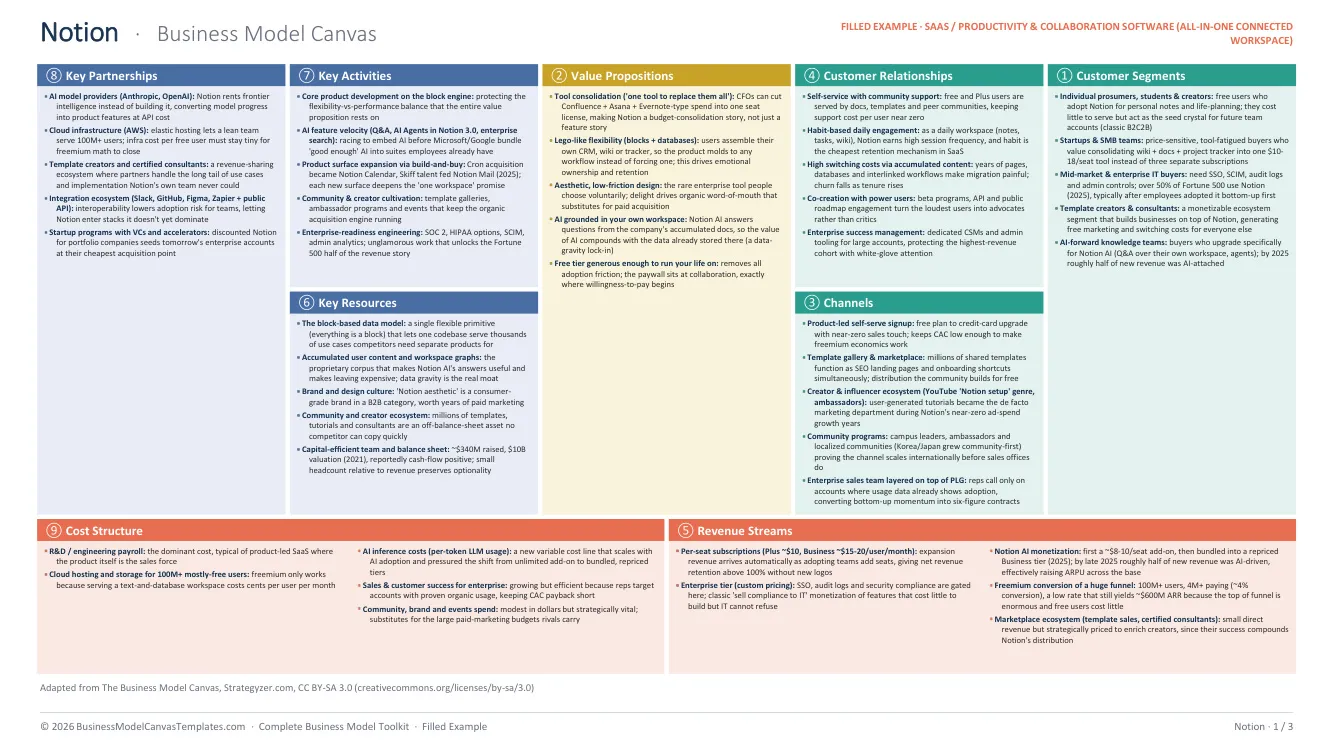
Notion’s model is a loop, not a funnel. Individuals adopt the free workspace for personal notes, bring it to work, and their teams hit collaboration limits: shared wikis, permissions, admin controls. At that exact moment, payment starts, at roughly $10-20 per seat per month. A sales team then converts the biggest bottom-up accounts into enterprise contracts, and employees who change jobs re-seed Notion at the next company. The numbers show how well the loop compounds: 100M+ registered users, 4M+ paying customers (about a 4% conversion rate), roughly $600M ARR by late 2025, over half the Fortune 500 on the product, and about half of new revenue attached to Notion AI.
The canvas at a glance
Here is Notion mapped across all nine blocks of the business model canvas.
Customer segments
- Individual prosumers, students, and creators: free users who cost little to serve and act as the seed crystal for future team accounts (classic B2C2B).
- Startups and SMB teams: tool-fatigued buyers consolidating wiki, docs, and project tracker into one $10-18 per seat subscription.
- Mid-market and enterprise IT buyers who need SSO, SCIM, and audit logs; over 50% of the Fortune 500 used Notion by 2025, usually after employees adopted it first.
- Template creators and consultants, plus AI-forward teams that upgrade specifically for Notion AI.
Value propositions
- Tool consolidation (“one tool to replace them all”): CFOs cut Confluence, Asana, and Evernote-type spend into one seat license. It is a budget story, not just a feature story.
- Lego-like flexibility: blocks and databases let users assemble their own CRM, wiki, or tracker, which drives emotional ownership and retention.
- AI grounded in your own workspace: Notion AI answers from the company’s accumulated docs, so its value compounds with the data already stored there.
- A free tier generous enough to run your life on, with the paywall placed at collaboration, exactly where willingness-to-pay begins.
Channels
- Product-led self-serve signup, from free plan to credit-card upgrade with near-zero sales touch.
- A template gallery and marketplace: millions of shared templates work as SEO landing pages and onboarding shortcuts at once.
- A creator ecosystem (the YouTube “Notion setup” genre, ambassadors) that served as the de facto marketing department during the near-zero ad-spend growth years.
- Community programs abroad (Korea and Japan grew community-first) and an enterprise sales team that calls only on accounts where usage data already shows adoption.
Customer relationships
- Self-service plus community support keeps support cost per free and Plus user near zero.
- Daily habit: notes, tasks, and wikis earn high session frequency, the cheapest retention mechanism in SaaS.
- High switching costs from accumulated content; years of interlinked pages make migration painful, so churn falls as tenure rises.
- Co-creation with power users through betas, the API, and a public roadmap, plus dedicated CSMs for enterprise accounts.
Revenue streams
- Per-seat subscriptions: Plus at roughly $10, Business at roughly $15-20 per user per month. Expansion revenue arrives as adopting teams add seats, keeping net revenue retention above 100%.
- Enterprise tier with custom pricing: SSO, audit logs, and compliance gated where IT cannot refuse them.
- Notion AI: first an $8-10 per seat add-on, then bundled into a repriced Business tier in 2025. By late 2025 roughly half of new revenue was AI-driven.
- Freemium conversion: 100M+ users, 4M+ paying, about 4% conversion, roughly $600M ARR.
Key resources
- The block-based data model: one flexible primitive lets a single codebase serve thousands of use cases that competitors need separate products for.
- Accumulated user content and workspace graphs, the corpus that makes Notion AI useful and leaving expensive.
- A consumer-grade brand and design culture in a B2B category, worth years of paid marketing.
- A capital-efficient balance sheet: roughly $340M raised, a $10B valuation set in 2021, reportedly cash-flow positive.
Key activities
- Core development on the block engine, protecting the flexibility-versus-performance balance the whole product rests on.
- AI feature velocity: Q&A, enterprise search, and AI Agents in Notion 3.0 (September 2025), racing Microsoft and Google bundles.
- Surface expansion via build-and-buy: Cron became Notion Calendar, Skiff talent fed Notion Mail (2025).
- Enterprise-readiness engineering (SOC 2, HIPAA options, SCIM) that unlocks the Fortune 500 half of the revenue story.
Key partnerships
- AI model providers (Anthropic, OpenAI): Notion rents frontier intelligence at API cost instead of building it.
- AWS for elastic hosting, so a lean team can serve 100M+ users at cents per free user.
- Template creators and certified consultants in a revenue-sharing ecosystem that covers the long tail of use cases.
- Integrations (Slack, GitHub, Figma, Zapier, public API) and VC startup programs that seed tomorrow’s enterprise accounts cheaply.
Cost structure
- R&D and engineering payroll dominate, typical of product-led SaaS where the product is the sales force.
- Cloud hosting for 100M+ mostly-free users; freemium only works because a text-and-database workspace costs cents per user per month.
- AI inference costs, a new per-token variable line that pressured the shift from an unlimited add-on to bundled, repriced tiers.
- Efficient enterprise sales, since reps target accounts with proven organic usage, plus modest community and events spend.
What makes this model work
1. The B2C2B flywheel. Individuals adopt free, bring Notion to work, teams hit collaboration limits, companies buy seats, and departing employees re-seed it at the next job. Notion pays almost nothing for this loop. The free tier is a marketing expense disguised as a product tier.
2. The paywall sits at collaboration, not features. Solo use is nearly free forever; payment starts the moment value becomes shared. That placement aligns price exactly with willingness-to-pay, which is how a 4% conversion rate on 100M users still produces about $600M ARR. It is a masterclass in designing revenue streams around behavior rather than feature lists.
3. Data gravity is the moat, and AI compounds it. Blocks can be cloned, and have been (Coda, Anytype, Microsoft Loop). Years of interlinked company knowledge cannot be exported cleanly. Notion AI weaponizes this: the AI is only as good as the workspace it reads, so switching costs now grow with every page written.
What you can steal
Place your paywall where value becomes shared. Do not gate features; gate the moment your product creates value for a group instead of an individual. Map your customer segments by willingness-to-pay, not by company size.
Let your community build your distribution. Notion’s template gallery and creator ecosystem generate SEO pages, tutorials, and onboarding for free. If users can publish artifacts made with your product, you have a channel competitors must pay to match.
Turn a variable cost into a pricing event. When AI inference costs made the unlimited add-on untenable, Notion bundled AI into a repriced tier and lifted ARPU across the base: half of new revenue by late 2025. Rising costs can justify a repackaging your customers accept if the added value is visible.
Want to map your own model the same way? Grab the free business model canvas template or work through the nine blocks step by step in how to fill in a business model canvas. The fully designed version of this Notion canvas, as a print-ready PDF plus an editable PowerPoint, ships inside the Complete Business Model Toolkit with nine other real-company examples.
Sketch your own model first, free
The blank canvas with guiding questions, in all 5 formats: Word, PowerPoint, Excel, and both PDF sizes.
Instant delivery. No spam, unsubscribe anytime.